
Caregiving Support | How Caregivers Get In Over Their Heads
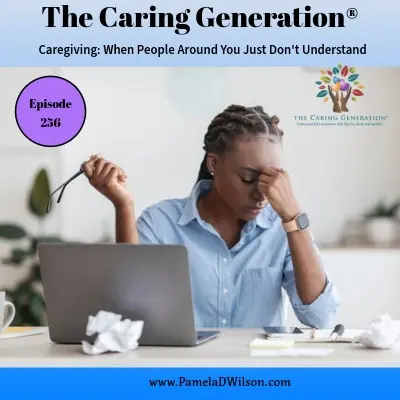
The Caring Generation®—Episode 256, October 21, 2026. Learn how adult children and spouse caregivers get in over their heads before realizing it’s time for a change. Family caregiving can feel isolating when the people around you don’t understand the demands of caring for aging parents.
Caregiving expert Pamela D. Wilson shares caregiving advice for handling challenging family dynamics, communicating what you need, and finding caregiver support before emotional and physical strain takes its toll. Learn practical elder care strategies to manage caregiving responsibilities and help prevent burnout.
This is a multimedia article feature.
Scroll down to read the article, select links to listen to the podcast, or watch the video. The article has links in “pink type” to related topics about caregiving, health, well-being, and self-care.
Click the round yellow play button below to listen to this episode. To download the episode, click the down arrow button. You can also use the scroll bar below the photo on the right to check out prior episodes and check out the show transcripts on Pamela’s website, featuring additional articles and links to educational tips for caregivers.
Do you have a care or caregiving question? Share your question with Pamela by completing the caregiver survey on her Contact Me page, scheduling a 1:1 consultation, or asking about eldercare mediation services.
Caregiving Support | How Caregivers Get In Over Their Heads
Family caregiving can feel isolating when the people around you, including your family and friends, don’t understand the demands of caring for aging parents, grandparents, or a spouse. Learn how adult children and spouse caregivers get in over their heads before realizing it’s time for a change.
Whether you are a caregiver who needs to reduce time spent in caregiving or remove yourself totally, or you’re an adult feeling overwhelmed by health problems or fearful about the future, hope exists. Making a plan can change your life for the better.
Read on to gain insight into how you might have gotten in over your head and identify three steps to start moving forward today.
 When Adult Children as Caregivers Get In Over Their Heads
Did you start helping out because you’re the child who lives the closest or is the most available?
The challenge of becoming a caregiver is not having early, hard conversations about what’s involved—time, money, tradeoffs, and risks to emotional and physical well-being.
Here’s why not having conversations about a caregiver’s role eventually leaves caregivers feeling like they’re in over their heads.
- You start doing little things. Caregiving hours and tasks consume your time.
- When caregivers are overly helpful, they create expectations from parents or a spouse that you will always be available whenever they need you.
- You put your parents’ or your spouse’s needs above yours.
Are you the caregiver who says yes to everyone but yourself? Have you sacrificed parts of your personal life? Is your time scheduled around your parents instead of time for yourself, your spouse, your children, or anything you want to do?
Has your job, career, or income been negatively impacted? Did you give up a promotion or change your work schedule to accommodate a parent’s or spouse’s care needs? Are your mental health and well-being suffering?
This is the life of caregivers who get in over their heads until they start saying “no more.”
Spousal Caregivers
 Are you a spouse caregiver who stayed silent while a husband or wife ignored health conditions and doctors’ recommendations? Did your husband or wife stop taking care of themselves years ago?
Ignoring the problem or hoping that your spouse would deal with it—when they didn’t—is why you’re a caregiver today.
If so, own your participation and stop enabling. You’re a caregiver who got in over your head. You can work your way out of doing too much.
Have you taken over tasks and, as a result, your husband or wife can’t do the things they used to?
Maybe you still work because you worry about paying the bills. You manage the money. Clean and maintain the house. Pick up prescriptions. Arrange medical care. Take the dog to the vet.
Is there anything you don’t do? The answer to this question may help you identify the extent to which you’ve gotten in over your head.
Aging Parents or Spouses Who Need Care
If you’re the person who needs care, how did this happen?
- Did you think you were bulletproof? Did you think nothing would ever happen to you?
- Are you that person who was “never sick,” but never made time for yourself?
- Do you lack information or education about health conditions? Did you ignore a doctor’s recommendations or refuse to see a doctor?
- Were there hereditary health problems in your family that you ignored?
- Are you the rare one who has done everything to stay healthy and still has a condition that makes daily life challenging? This can happen despite one’s best efforts. The question is, what will you do about it?
Regardless of the situation, start doing more for yourself. What choices would you make if you had to do it all yourself?
- If you are an in-over-your-head caregiver who wants more “you-time,” make a plan to reduce your caregiving time.
- If you have health problems and need care, learn what you can do to become less reliant on your children or a spouse when possible.
Your spouse or children may help, but it’s really up to you to pull yourself up by your bootstraps to improve your situation. It’s time to make life easier for your caregiver who got in over their head.
Educate yourself. Research resources and services so you can become more independent and less reliant.
Find Hope
The bright spot is that if you realize you’re in over your head and something has to change, then you are in the perfect place to figure out next steps. You’re ahead of other people who are stuck. People who do the same thing day after day and expect something different.
How to Stop Doing Everything and Motivate Elderly Parents to Do More for Themselves
Click the red arrow button in the picture below to watch the video.
Watch More Videos About Caregiving, Aging, and Health on Pamela’s YouTube Channel
Three Steps to Re-Balance Caregiving Roles
1 Learn and practice mental discipline
Train your brain to override short-term impulses and distractions that waste time. Figure out what you want your life to look like and visualize what taking one step each day in the right direction looks and feels like.
If you’re an overwhelmed caregiver, you may need to start small. Look at your relationships. Stop giving your time to people who give you nothing in return. Start saying no instead of yes. Do something for yourself every day, even if you start with just 10 minutes.
 If you are a spouse or an aging parent who has become reliant on others for help or care, identify one aspect of your health you want to improve and the steps you’ll need to take to make it happen.
Talk to your doctor and learn options to improve your physical and mental health. Investigate them. Choose which ones you will prioritize and get to work.
If you’re burned out, exhausted, frustrated. stop complaining about your situation. Stop perseverating on how bad it is. If you can’t get past negative emotions, you won’t be able to make different or better choices.
To move forward, identify when you’re thinking unhelpful or negative things and stop yourself. Create a sentence or a behavior pattern to refocus your brain.
Instead of saying I’m a bad caregiver, or I’ve let my health go, say I got in over my head. I’m going to work myself out of it by doing one thing every day.
2 Wake up and realize every day is a new day. Be positive in thoughts, words, and actions. Do the things you committed to do. Become a person of your word to yourself and others.
Create a timeline of doing X today and every day until you get it right. Then move to Y, Z, A, B, C.
Know that you’ll run into hard realities and challenges.
 For example, hiring in-home non-medical caregivers for elderly parents isn’t a perfect process. You may have to work through several agencies and caregivers before you find one that works out.
In-home care agencies typically have employee turnover of at least 50% over a 6-month to one-year period. I know because I owned and operated a non-medical in-home care agency for 7 years.
Alternatively, investigate assisted living, memory care communities, or a nursing home. The process will be educational.
Don’t expect perfection. No care service is perfect. Good sometimes has to be good enough.
And while you’re investigating and planning options to give you back your time, realize you didn’t create the problem. Learn from it.
If you’re the person who needs care, you own the problem. It’s as much up to you to research and identify potential options and solutions.
3 Stretch yourself to be more flexible and resilient than you believe you can
Don’t let small problems take you off track. Remain positive.
 As you move forward, get good at identifying unexpected problems and roadblocks and eliminate them.
Think of making progress in the context of renovating a house, which is something a lot of people have done.
Let’s say you haven’t maintained your house. It’s falling apart. Caregivers get in over their heads, and life starts to fall apart.
Imagine the house as the body of the person who needs care, or the caregiver who has ignored their health.
You need a home inspector or a primary care doctor to give you a baseline status of the structure so you can prioritize what to work on.
As many of you know, once you repair something in a house, you find the next thing.
Sometimes you’ll take 10 steps ahead and three steps backward to regroup before you move forward again.
Be Flexible, Patient, and Kind With Yourself
Being flexible, patient, and kind with yourself and others is extremely important. These skills help maintain a high degree of mental discipline.
Not everyone is successful the first time. It may take you several tries. I encourage you to keep going.
If you get knocked down – get back up. Caregivers get in over their heads, and you’re on your way out.
If you’re the person who needs care, letting health problems control your life is over. Take control so that you feel better, stronger, and more alive day by day.
 This is your life. You get one chance to get it right and live the life you want for whatever time you have left. Make the best of it.
Do You Want to Create a Plan to Care for Aging Parents or Yourself? Schedule a 1:1 Virtual Consultation with Pamela D. Wilson.
©2026 Pamela D. Wilson, All Rights Reserved.