
Signs Parents Need Memory Care
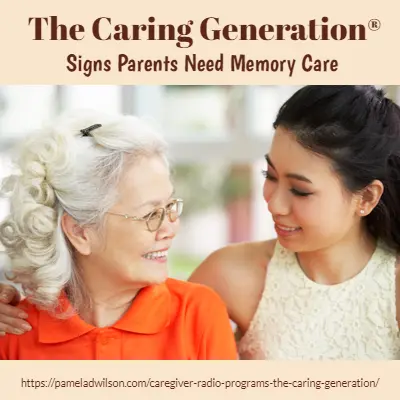
The Caring Generation® – Episode 134 April 20, 2022. Signs parents need memory care include many considerations: caring for elderly parents at home, considering a memory care or assisted living community, navigating emotions, and more. Caregiving expert Pamela D Wilson interviews Dr. Stephen G Post about decisions that family caregivers must make when loved ones with memory loss reach care at the end of life.
This is a multi-media article feature.
Scroll down to read the article, select links to listen to the podcast, or watch the video. The article has links in “pink type” to related topics about caregiving, health, well-being, and self-care.
Click the round yellow play button below to listen to this episode. To download the episode, click the button, which resembles a downward-pointing arrow. You can also use the scroll bar below the photo at the right to check out prior episodes.
Do you have a care or caregiving question? Share your question with Pamela by completing her caregiver survey. Learn more about how Pamela can help you with a virtual or telephone caregiver consultation by visiting Pamela’s elder care consulting page.
When Does a Parent Need Memory Care?
Signs that parents need memory care include monitoring a wide range of activities, supporting daily care, and making medical decisions. The first question you might ask is, What is memory care? If you search the Internet, the term’ memory care’ is typically associated with a memory care community, a company that offers apartments and care services for individuals with memory loss. But, if your parent has memory loss, a memory care community may not be what you need—at least not yet.
Discussing signs that parents need memory care can begin with the idea that memory care encompasses any type of assistance for a person with memory loss, from the early stages to the end of life. On the topic of end-of-life or extensive care for deeply forgetful people, Dr. Stephen G Post will be joining me after the break to talk about his book, Dignity for Deeply Forgetful People: How Caregivers Can Meet the Challenges of Alzheimer’s Disease.
If you like what you hear today, I encourage you to search for Episode 26 of the Caring Generation, How to Talk to a Parent With Dementia, which features a previous interview with Dr. Post. He is the founder of the Institute for Research on Unlimited Love at www.unlimitedloveinstitute.com, where you can learn more about him. He is also an author and advocate for persons with memory loss.
Early Signs Parents Need Memory Care
Identifying simple signs parents need memory care can be seen in written reminders around the home. For example, when forgetfulness first begins, you might notice inconsistencies in the behavior of a loved one that relate to disorganization in the house, forgetting appointments, and having difficulty with activities that a parent once performed, such as clockwork.
Other signs that parents need memory care include piles of mail around the house, stacks of items, and repeated purchases of the same things—such as four jars of peanut butter—when this extent of disorganization would have never appeared in a parent’s home before. Are you noticing late notices in the mail for unpaid bills? Did mom or dad forget to complete their income taxes, or do they forget conversations?
As time passes, you may notice an increase in difficulty managing medications or attending doctors’ appointments. Additionally, a parent may lose weight because they live alone and forget to eat. Is the refrigerator filled with spoiled foods or canned goods in the cabinet that have been there for years?
Small Details Make a Big Difference
All of these day-to-day details that require ongoing attention—assuming that your parent was attentive to them before—can be signs parents need memory care reminders or support. Physical signs include difficulty walking, poor balance, and an uneven gait – spelled gait. You can look up the word gait and learn more about its definition.
Gait refers to the act of putting one foot in front of the other and walking in a balanced manner. Walking takes a great deal of physical and mental energy to coordinate, and when a person has memory loss.
The coordination required to walk is one area where weakness or general physical decline is noticeable. So let’s say you are noticing one or more of these signs that parents need memory care and aren’t sure what to do.
How Do I Know if A Parent Needs Memory Care or Assisted Living?
Click the red arrow in the picture below to watch the video.
Watch More Videos About Caregiving, Aging, and Health on Pamela’s YouTube Channel
Talking to Elderly Parents About Memory Loss
If you haven’t, the first thing to do is talk to your parent about seeing a doctor for a general health evaluation that includes memory loss testing. That conversation goes like this. “Mom or dad, I’m noticing that things you used to do around the house might be getting a little more difficult. Are you noticing the same?”
The idea is to begin a conversation with elderly parents about signs parents need memory care. I never suggest starting by pointing out forgetfulness because parents don’t want to be chastised for making mistakes or being continually forgetful.
However, you can also address memory and health concerns in the conversation. If forgetfulness is an ongoing concern, you can say something like, “I think we talked about that before. Maybe it’s me who is getting a little forgetful. What do you remember about our conversation?
And then see what a parent can tell you. Then talk to your parent to schedule a general check-up and a memory care evaluation. Standard memory evaluations go by acronyms healthcare providers use, like MMSE, SLUMS, MoCA, Mini-Cog, and others.
Diagnosing Memory Loss
A question to ask a primary care doctor, if they are a general practitioner, is—What is your experience diagnosing memory loss? I say this because some general practitioners have minimal experience others who work more with the elderly can be a good starting point for the diagnosis.
In all cases, I recommend a referral for an appointment with a neurologist or neuropsychologist for a more comprehensive evaluation of memory loss. Here’s why. Early memory loss can be diagnosed with the initials MCI, which means mild cognitive impairment.
But what the doctors don’t tell patients, unless the patients know to ask, is how does MCI trend over time. For example, people who have MCI today are more likely to have progressive memory loss or be diagnosed with dementia or Alzheimer’s in time.
Knowing how a diagnosis of mild cognitive impairment or early memory loss progresses allows planning for care needs. Many actions can be taken to provide support in the home before moving a parent or spouse out of their home into a memory care community.
Safety is a Care Consideration
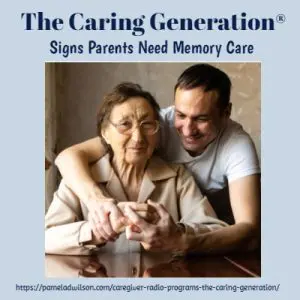 One of the most critical aspects confirming that aging parents need memory care is the idea of safety. Initially, early memory loss may not be significant.
A parent can still drive and perform most activities around the home safely, such as cooking, remembering to take medications, and so on, especially with the help of reminder systems like alarm clocks, notebooks, and phone calls from you.
But over time, there will be a point where it becomes questionable whether a loved one is safe living alone at home. Warning signs include actions such as forgetting to eat, losing weight, poor balance, frequent falls, neglecting to shower, wearing the same clothes day after day, and failing to take medications.
If your parent has memory loss, they may disagree with you that these events occur. All of these are early signs parents need memory care.
Establishing Memory Care Routines
The good thing about noticing the little things and signs parents need memory care is that you can put reminders and additional care in place. You can be the reminder, or you can use technology to assist.
You might initially be the caregiver visiting elderly parents daily and on the weekend. After that, you may hire a caregiver because you can’t be there all the time.
Day programs are re-opening now that COVID is an ongoing issue like the flu that everyone can get—instead of this unknown and frightening event. I’m not saying that COVID is not serious for the elderly with chronic conditions—it is—and even more so for the elderly diagnosed with memory loss.
Please note that day programs and care communities may require parents and visitors to be vaccinated against COVID-19 if you, as a visitor, wish to participate in the general part of the community with other residents. These requirements may change over time as we learn more about COVID and the effectiveness of vaccines.
There are many options for setting up daily systems to care for aging parents. You can find these resources in my online caregiver education program, Caring for Elderly Parents.
Learning and Talking About Memory Loss
As a caregiver of a person in the early stages of memory loss, there is a lot to learn. The earlier you embrace the learning journey, the more prepared you will be for the unexpected events that will happen.
It is essential to initiate early conversations about what a parent wants for care, what parents expect you to do for them, and how to pay for care. Additionally, legal decisions surrounding care and finances are essential. These are discussions that most families avoid until care needs advance and emotions are high due to the ongoing stress of being a caregiver.
The best time to have these conversations is immediately when you notice signs that parents need memory care. While no one likes to talk about Alzheimer’s or dementia, not talking about it will result in more complications.
If your parent is at the stage where memory loss has been ongoing but is now formally being diagnosed, your conversations may be different from those of a family with newly diagnosed early-stage dementia. In this case, if your parent is in the very early stages, they can probably have rational conversations about making a plan and clearly state their needs.
What To Do When It’s Too Late for Rational Conversations
However, if mom or dad is in the middle to later stages, the time frame for having these conversations may have passed. How do you know?
Are you getting frustrated about the information your parent is unable to remember? Do you feel that your parent is purposely being forgetful to irritate you? Is the ability of your parent to retain information very short-term?
Does mom or dad repeat questions? If so, don’t become frustrated; become educated. The forgetfulness will only get worse.
What Compassionate Care Means
Imagine the frustration your parent might experience being unable to remember words or complete entire sentences. Develop compassion and cultivate patience.
If you can no longer be the caregiver and are considering a care community, consider how to create the best experience of compassion for your parent. Stephen Post will talk about this in the next segment.
What compassion means for a parent moving into a care community is the thoughtful steps that the caregiver takes to set a parent up for success. Many adult children want to place their parents in assisted living with people not like them.
Assisted living communities are filled with aging adults of similar ages who may have some memory loss, but not to the extent that they are unable to complete sentences or engage in conversations that make sense.
When considering the frustrations you experience with your parents, specific to communication, why would you want to place your parents in a similar situation where others might be equally or more frustrated or impatient with them?
Think about that for a moment. The best situation is to find a community where the other residents, or at least some of them, are at the same level of forgetfulness and communication as your parent or a spouse.
When a Parent Needs A Memory Care Community
Finding the right care community may mean visiting 5 to 10 locations to find the best fit. In the long run, this is a good plan. Moving a parent multiple times because you chose the wrong community will be significantly disruptive for your parent.
The first move will be emotionally challenging because you are relocating a parent with memory loss to strange surroundings. Each time you visit and leave, a parent may ask to go home with you. But once Mom or Dad adjusts, the care community will become their safe haven.
Even when moving a parent to memory care, it’s important to continue visiting to oversee Mom or Dad’s care. The staff at care communities can only do so much because, while they are available 24/7, they are not always in direct contact with your loved one all day.
There is a significant difference between the larger communities, which have hundreds of residents, and the smaller personal care homes, which typically have two to ten residents. When a parent needs memory care, these smaller communities can provide more individualized care and more assistance when needed.
When Is the Best Time to Move a Parent?
 Family caregivers ask when is the best time to move a parent. There is no one best time.
A balance exists between moving a parent to a larger community where they can be more active, socialize, and meet people, versus moving or relocating a parent when memory loss advances and hands-on care needs increase.
As a caregiver, you want to be compassionate with yourself and not wait too long to seek help. When you reach a point of frustration or burnout, it can be more challenging to see clearly and make the best decisions. Taking a deep breath of compassion and time to consider the overall situation can help caregivers make good choices.
18:40 (Timecode if you are listening to the podcast)
Interview With Dr. Stephen G. Post
Stephen Post is a return guest to The Caring Generation. His work at the Unlimited Love Institute blends research about the health benefits of love and gratitude. You can learn more about him at The Institute for Research on Unlimited Love.
Pamela D Wilson: Stephen, thank you so much for joining me.
Dr. Stephen Post: Hi Pamela, It is a pleasure.
The Difference Between Early and Late-Onset Alzheimer’s Disease For Caregivers
Pamela D Wilson: So we are here to talk about your latest book about dignity for people with memory loss, and I made a list of questions for you, so I’m just going to jump in. So let’s start with Alzheimer’s and the fact that it’s typically only thought of as a late-onset disease, that only old people get Alzheimer’s.
But there’s a lot of research showing that people are getting this at a younger age, especially in the Hispanic population. To support the idea of dignity, how would you advise a family caregiver who has a loved one in their 20s or 30s who is raising babies and they’re caring for a spouse—advise that person versus a family caregiver who is taking care of a spouse or a parent in their 80s. What advice would you give?
Dr. Stephen Post: Often, they have a particular gene called the Presenilin2 Gene, and that gene is closeted.
It’s not just a risk gene. If you have the gene, you will have the symptoms, and its progression is very quick. It will usually go from diagnosis to dying within five years. It’s always ubiquitously behaviorally complicated.
So it’s quite a different situation than the late-onset Alzheimer’s, which might hit at age 60 or 65 or 70, 75, or 80. It’s very different in its dynamic, and it creates huge problems.
I’ve known a woman who had a PS1 genetic test. She did not know that she carried the gene because she didn’t want to have the test. But she knew that her father had because her father had gotten Alzheimer’s when she was a teenager.
And she did not want to see her daughter or son go through that. So she had a pre-birth test, and it turns out that her baby did carry this dominant gene. So she had a selective abortion which was very controversial in the minds of many people.
But on the other hand, she did not want her—she obviously knew that she carried the gene. Once she found out that her fetus carried the gene, she did not want to bring a child into the world that would have to care for her during adolescent years.
And so these things are very, very, complicated and they involve all kinds of genetic tests, and they’re not easy to figure out. But boy they make life difficult early on for caregivers.
Medical Treatments vs. Quality of Life
Pamela D Wilson. Well, and let’s kind of follow that line of conversation, so things that make life difficult for caregivers of people with Alzheimer’s who have other chronic diseases like maybe cancer or heart disease or you know they’re going for dialysis, how can families talk about that with dignity to really talk about, “Do you really want to go through all of these treatments? Is it giving you quality of life?”
Dr. Stephen Post: Well, I don’t think that the vast majority of people with progressive dementias should have these other collateral conditions treated. I don’t think it makes much sense.
We had a patient with Alzheimer’s disease who had been very clear that she did not want her cancer—she had a relatively large tumor that needed to be excised. She did not want that treated as she grew more and more forgetful. And in the end, she was not treated, and we felt fine about that.
Because there’s no real need to use all of this highly invasive technology for people who don’t have any insight, to speak of, about what it’s for. What it’s about.
It’s going to do so much more damage to their cognitive state of being in the hospital and having a tube in every orifice, natural and unnatural, and having the lights blinking and the buzzers buzzing. It’s actually a formula for disaster.
Natural Dying vs. Treating Chronic Conditions
And so, therefore, I think that if someone has a chronic heart condition, if someone has a cancer—unless it’s palliative. There was one instance where even though one individual said they did not want to have their cancer excised, it became impossible to keep them comfortable otherwise and so that was an exception.
But there are many, diabetes—I’m not at all certain I suppose that’s a judgment call. But I’m not certain somebody needs to be treated for diabetes when they’re getting into the advanced stages of Alzheimer’s disease.
I basically am a believer in natural dying. And that includes hands-off with a lot of the normal illnesses that are associated with old age.
Caregivers vs. The Healthcare System
Pamela D Wilson: Well those of us who work in the industry understand this, but my perception or I guess my experience is that people who are outside of the Alzheimer’s world or who don’t’ understand don’t really see this. And an example is the healthcare system.
I had a client years ago who went into the hospital, and the surgeon wanted to put in a pacemaker. And even though I had documentation from the cardiologist stating that it wouldn’t make any difference. The surgeon did the surgery.
And so how do family caregivers who have legal responsibility advocate for loved ones when the healthcare system can prioritize surgeries or treatments that honestly make the hospitals money?
Dr. Stephen Post: Well absolutely. You have to be a very firm advocate. Now every department of medicine in a major hospital has a big revenue source when it comes to placing feeding PEGS (percutaneous endoscopic gastrostomy tubes) through the belly.
And this provides artificial nutrition and hydration. However, it’s also one of the major reasons why individuals with dementia are restrained because they have no idea what that little bit of rubber is sticking out from their tummy.
And then they pull it out. And then they get tied down. Then oftentimes, they’re sitting in their urine or whatever. They get infections. There are all kinds of sequelae (a health condition that is the consequence of a prior disease) that are not good for them.
The Feeding Tube Debate for Persons With Memory Loss
And in fact, if you use a feeding PEG, you will not extend life. On average, people live longer without a feeding PEG. But you do need to practice assisted oral feeding, which I did with my grandmother so many years ago before anybody thought of using a feeding PEG.
Feeding PEGS were only invented in 1979, and the first feeding PEG was used in a nursing home in 1985. Not because it was good for anybody but because it was financially lucrative. And they could also fire a lot of the people on staff who did assisted feeding, which is a bit of an art form.
So I think you want to keep people away from this and all this. In Canada, nobody gets a feeding PEG. They just don’t do it. In most parts of the world, they don’t do it. Now, in America, it depends on what region of the country you are in.
But I think it’s a bad idea, and it’s inconsistent with a comfortable, natural dying. Although again, this is a little counterintuitive for people because they think, Wow, aren’t you starving him to death or dehydrating her to death?
The Body’s Palliative System
Actually, not at all. The body has its own natural or palliative endorphin system, and these chemicals kick into action in the absence of hydration and nutrition. It’s important hydration because if there is hydration but not nutrition, they will not get this natural pain relief, and it will be more difficult for them.
But there’s no—even a hip fracture. If someone has a hip fracture and they have severe dementia. It doesn’t make much sense to bring them into the hospital and give them surgery. You basically want to keep them out of the hospital. It’s the most disorienting experience they can have.
And if they have the hip surgery and they get back into wherever they are staying they’ll be more disoriented than ever before and they’ll never come back to their former quality of life. And so the hospital is a bad place for a person with Alzheimer’s.
Pamela D Wilson: It’s a bad place for any older people, in my opinion.
Dr. Stephen Post: It is.
Caregiving: Extending Life and Feeling Guilt
Pamela D Wilson: You know, I imagine that my listeners are hearing you and I talk about this very plainly or straightforwardly, and some of them are going to be kind of shocked. I had a caregiver say the other day, “at what point do I stop pushing my parent to stop doing something and I said, “well did you ask your dad if he wants this care?”
How can caregivers get over their guilt to support the dignity of really what their parents want or what a person with Alzheimer’s who really can’t express their wishes but may have told them years ago what they wanted? How can they—how can caregivers feel okay with all of this?
Dr. Stephen Post: Well, they shouldn’t feel guilty at all in being compassionate. And compassion means that a person does not have to die if they have no insight into these technologies. They have no insight into these environments—why put them through it? That’s not unkind.
Now, of course, sometimes an adult child will have a different attitude than an older spouse. Lots of studies show that the older husband, the older wife, will also be looking back on life. Been there done that. And they’ll be willing to say no to a feeding tube or no to this particular surgery or no to that.
When To Stop Pushing Elderly Parents to Accept Care
Whereas the adult children are used to getting on the phone and saying “hi mom, it’s me,” after all these years. They have what psychologists call attachment, and that’s perfectly normal and reasonable.
But I think as professionals, we have to be able to help these adult children realize that they don’t need to push in this direction. So I’ve done a lot of that.
You know, during the COVID episode, there was a woman with Parkinson’s disease who was in her mid-80s, and secondary to Parkinson’s, she had dementia. She was up in the intensive care unit at a given hospital which I shall not name. And they wanted to put her on a vent.
And I know with people in that situation if they go on a vent they will probably never get off it. She was on a non-invasive breathing mask which was perfectly fine. And she could actually sometimes take it off and have a brief conversation with her loved ones down in the lobby. They didn’t have to come into the intensive care unit.
But the daughter said you know my mother deserves the best. She deserves a ventilator. And in a very diplomatic and generous way, I said, look, you know if you put her on this ventilator. First of all she’s going to be sedated. That will completely devastate her lucidity of mind permanently.
I said, “the likelihood of her getting off this machinery is probably 1 in 10 at best. “And I said you have a right to make a choice because you are the family surrogate by law in the state of New York.
However, let me just recommend something. And I said this very lightly. “At a certain point, you want to put all that stuff on the shelf and just ask yourself, what’s the compassionate thing to do?”
Compassion means to relieve suffering. To intervene and to ameliorate suffering. Not to increase suffering.” And I said, “that’s what you need to think about, so give it some reflection.”
And then, she decided that she would just go with the non-invasive breathing mask. And actually, her mother did okay with that.
Clarity About Life-Ending Desires
Pamela D Wilson: Well, and one more question for you, and this is kind of flipping the idea of compassion but back to the caregivers. So I have a lot of family caregivers who have been doing this for ten or twenty years, and they have—honestly, they’ve given up their marriages, their careers, their money and they ask how much longer can I go on like this?
And I say to them, look at what you’ve given your parents. They may not have lived this long if you were not involved. Unfortunately, you gave up a lot.
But at what point can caregivers become compassionate with themselves to set boundaries about not unnecessarily extending the life of a parent?
Dr. Stephen Post: Every study we have of competent older adults in geriatric clinics indicated 97% of them don’t want anything done to extend their lives should they go into an advanced state of progressive dementia or whatever disease it might be caused by. They simply don’t want it, and they’re very clear about that.
And we need to be clear about it with them. We need to talk about it with them.
Their one assurance of safety and hope is that they will not be aggressively treated. And indeed one of the main reasons why there are people who go off to say Dignitas in Switzerland and avail themselves of assisted suicide or go off to the Netherlands to get euthanasia or go off to Quebec now where this can be done.
We need to just completely change the model. Demedicalize it because the medical model can do very, very little. It can keep people comfortable. And that’s good. But we need to do nothing to extend their lives. It’s actually very sad that we insist on doing this.
Pamela D Wilson: Stephen Post I thank you so much for joining me. I thank you for all the work you do on behalf of deeply forgetful people
Dr. Stephen Post: Thank you, you do such a nice job and I want to say you have a wonderful voice and a great tone.
Difficult Choices When Parents Need Memory Care
Straightforward conversations about the progression of memory loss and the care desired at the end of life can relieve adult children and spousal caregivers of guilty feelings. While many parents tell their children that they’ve lived their lives—that it’s time for their children to live their lives—some adult children are too emotionally tied to a parent to move ahead.
What can an aging parent or spouse do to prepare in advance for these situations? Should parents and spouses be so specific as to put their wishes in writing so that their caregivers can re-read these instructions when care needs outweigh the benefit?
 Due to the level of advancing memory loss, there will be a time that parents may want care but not understand the consequences of this request to their children. Considering wishes for life-extending care when clear of mind provides the best opportunity to put your wishes in writing.
In addition to estate planning that includes appointing agents under a medical and financial power of attorney, creating a living will and a will or a trust, writing a personal letter with your wishes can provide clarity at the end of your life.
This letter, in addition to the estate plan, written prior to advancing health concerns might offer the peace of mind that family caregivers need to follow through with your wishes.
Looking For Help With Your Caregiving Situation? Learn More About Scheduling an Elder Care Consultation With Pamela D Wilson
©2022 Pamela D. Wilson All Rights Reserved