
Failing as a Family Caregiver
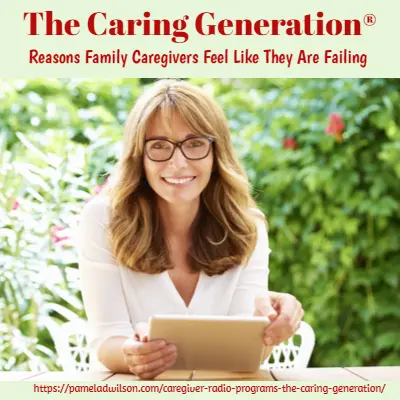
The Caring Generation® – Episode 135 April 27, 2022. Do you feel as if you are failing as a family caregiver? Pamela D Wilson, caregiving expert, shares eight reasons family caregivers struggle. Learn how guilt or feeling responsible for things not in the control of caregivers can result in feelings of failure, and how to look at care situations more objectively.
This is a multi-media article feature.
Scroll down to read the article, select links to listen to the podcast, or watch the video. The article has links in “pink type” to related topics about caregiving, health, well-being, and self-care.
Click the round yellow play button below to listen to this episode. To download the episode, click the button, which resembles a downward-pointing arrow. You can also use the scroll bar below the photo at the right to check out prior episodes.
Do you have a care or caregiving question? Share your question with Pamela by completing her caregiver survey. Learn more about how Pamela can help you with a virtual or telephone caregiver consultation by visiting Pamela’s elder care consulting page.
Reasons Family Caregivers Feel Like Failures
Failing as a family caregiver is a complicated subject because the idea of failing at a job you felt pressured to accept may seem unusual or unfair. Many family caregivers tell me that they had no choice but to become caregivers for an aging parent or a spouse. There was no one else because brothers, sisters, and other family members refused to help.
The words “fail” and the idea of being a failure evoke many negative emotions, especially if you feel that you have failed in one aspect of life. Maybe you didn’t get the job you wanted, the guy or girl you fell in love with, or you weren’t chosen to be on a team. Many events in life can make us feel like we could or should have done better, and we may have regrets.
Differences in Failing
The difference between failing as a family caregiver and failing in other aspects of life is that we often relate failure to something we want, rather than something we don’t want. If we’re being honest, most people don’t add the title or the role of a caregiver to the top of their bucket list. I doubt that being a family caregiver is at the top of the list of New Year’s Resolutions that you make year after year.
Traditional Advice About Failing vs. Advice for Family Caregivers
Anytime we set a goal, the potential for failure exists. The more successes we have, the less we worry about the possibility of failure.
Although failing can be painful to the ego, it also offers valuable lessons about how to approach situations differently. For example, I always recommend having a plan and a backup plan for caregivers.
One positive action you can take is cultivating a mindset that acknowledges plans may need to be adjusted based on unexpected situations or outside factors that caregivers cannot control. Traditional wisdom about failing includes being persistent, not making excuses, holding yourself accountable for results, learning from past mistakes, being disciplined, and maintaining a positive attitude.
Becoming a Caregiver is an Unpredictable Territory
Becoming a family caregiver is something that most of us do eventually in one way or another. But, whether you have children—yes, parents are caregivers—or you care for other people in your family, there will be situations you can’t predict.
For example, many situations arise when you care for an elderly parent or spouse who has physical difficulty getting around, multiple health issues, or memory loss. Increasing involvement with community services, healthcare, and other providers can complicate decision-making.
Do You Feel You Are Failing to Be a Good Caregiver?
Click the red arrow in the picture below to watch the video.
Watch More Videos About Caregiving, Aging, and Health on Pamela’s YouTube Channel
Eight Common Caregiver Problems That Lead to Failing as a Caregiver
Let’s examine eight common caregiving problems that can lead family caregivers to feel like a failure. These issues are the factors that make feeling like you are failing as a caregiver different from other types of failures.
1 – Physical Health
Physical health concerns are the number one contributor to feeling like you are failing as a caregiver. These are health concerns belonging to an elderly parent, spouse, or care receiver. But eventually, due to the stress of the caregiver’s many roles, the caregiver experiences health problems.
For caregivers, diagnoses like high blood pressure, generally not feeling well, frequent colds, or other minor annoyances result from physical and mental exhaustion. Caregivers work nonstop.
How many caregivers dream of taking a nap or going for a walk, but that list of all the things to be done outweighs the importance of taking care of themselves? Caregiving becomes unbalanced when caregivers fail to take time for themselves because they say yes to being helpful, resulting in not having enough time to get everything done.
Overscheduling and Overcommitting
Overscheduling and overcommitting are actions contributing to where failing as a family caregiver begins. Family caregivers who feel that they have to do it all rarely consider asking for help or seeking assistance.
Caregivers begin doing X or Y, and then add A, B, and C. Suddenly, there is an entire alphabet list of 26 things you have to do.
What if, instead of this list of things you feel must be done, you consider various aspects that contribute to failing as a family caregiver? Are you weary or exhausted? If so, feeling exhausted might mean that you fail to get enough sleep, may not be eating a nutritious diet, or do not make time for yourself for self-care like meditation or exercise to have more energy.
Degrees of Failure
Failure doesn’t have to be a big, colossal, life-changing event. When you think of it, avoiding failure can be as simple as realizing that something isn’t right.
Mom or Dad has a fever this morning. They don’t seem as cognitively aware, refuse to eat, or seem a little off. Noticing these tiny changes in condition can help avoid significant health issues, such as pneumonia or an infection that can rapidly worsen.
A Lack of Self-Care Contributes to Health Concerns
It’s essential to examine how the actions of family caregivers might contribute to sleep problems, a weakened immune system, or new health issues that didn’t exist thirty days ago. For example, are you feeling more stressed, irritable, or impatient?
These changes in the physical body or emotions are warning signs of being rundown or moving toward an unbalanced life. So let’s translate these concerns to aging parents and spouses.
As a family caregiver, you may feel guilty or responsible for your loved one’s poor health. However, the bottom line is that your actions did not create your parents or your spouse’s health problems.
Are You A Fixer?
While caregivers dream of fixing problems and the day-to-day struggles of aging parents, maintaining or managing concerns may be the best that can be done. One example is caring for a mother previously diagnosed with high blood pressure who has a heart attack and now feels tired all the time.
Because of the heart attack, Mom can’t be as physically active as before. Overall, she doesn’t feel well and spends most of her time in bed or sitting in a chair in the living room watching television. It’s almost as if mom doesn’t care about trying to help herself feel better.
Caretaking: A Caregiver’s Need to Be Needed
As the caregiver, you didn’t create mom’s health issues in this example. But you may be affected by her health issues if you accept the role of being her caregiver.
While you might feel like you bear responsibility for another person’s health or emotional state, you don’t own the problem. Fixing isn’t your job.
If you feel that you are failing as a family caregiver, ask yourself why you feel responsible for solving other people’s problems or making them happy. There is a big difference between being a caregiver and being a caretaker.
For more on this topic, including research about co-dependent relationships, listen to The Caring Generation podcast Episode 93, When You Can No Longer Care for Elderly Parents.
Setting Caregiver Boundaries
One of the best ways to avoid failing as a family caregiver is to set boundaries early in caregiving relationships. While you may be committed and feel responsible for caring for dad, mom, grandma, grandpa, or a spouse, feelings of duty can go too far when you take on everyone else’s work.
Owning actions and behaviors is each of our responsibilities. Your mom, who had a heart attack, may have had high blood pressure for years. Maybe the doctor told mom to quit smoking, exercise, lose weight, and eat healthily, and mom decided that being healthy was too much work, so she ignored the doctor’s advice.
As a result, today, Mom’s life is negatively affected by health concerns. This doesn’t mean that, as caregivers, one cannot feel compassion or empathy. It does mean that caregivers should not feel like they have failed when a loved one’s health worsens.
Care Receivers Can Feel Like They Have Failed
Care receivers may feel like they’ve failed and experience regret about not adopting healthy habits. One of the hard truths is that changes in health occur for various reasons, some of which are explainable and others not.
At some point, the body fails and dies. A loved one’s health worsening is usually not due to intentional neglect by family caregivers.
Health problems tend to worsen in severity over time. To avoid feelings of failure as a family caregiver, caregivers and care receivers must accept responsibility for their actions and what they are willing to do to make changes.
Some health conditions can be maintained when proven to halt the declines are implemented. Watching a parent or spouse suffer from physical health issues can serve as a red flag warning for adult children and spousal caregivers to pay more attention to their health.
2 Changes in Emotions or Mood
 Number two for failing as a family caregiver is experiencing ongoing changes in emotions or mood. Managing a care situation can feel uncontrollable when emotions fluctuate from feeling happy and depressed to frustrated or guilty.
Caregivers and care receivers can experience isolation, depression, anxiety, guilt, sadness, worry, irritability, frustration, anger, grief, and many other emotions.
When caregivers trade parts of their lives to care for elderly parents or a spouse, something—work, relationships, social lives—suffers.
Focusing on one thing or part of your life means being less attentive to another. This lack of focus on something previously important to you may make you feel like you are failing as a family caregiver.
Feeling Abandoned or Isolated
You may feel abandoned and alone if you are the person doing it all. Feeling alone may mean that you feel as if you are failing at your career, not paying enough attention to your marriage, or losing friends. In addition, your children may be struggling in school because you spend more time with aging parents than with them.
Caregivers experiencing all of these emotions can become stuck when they prioritize the needs of aging parents or a spouse over their own personal needs. While a shift in focus is sometimes necessary for some time, setting a boundary to define the length of time you are willing to make tradeoffs will help you plan to reset your life and priorities.
3 Memory Loss or Cognitive Declines
Number three for failing as a family caregiver relates to loved ones diagnosed with memory loss or those who have shown telltale signs for years. If you are a child who lives hundreds or thousands of miles away from a parent and doesn’t see them frequently, it may not be as easy to identify memory gaps.
On the other hand, you may be an adult child who hears one parent complain about caring for the other. You live a thousand miles away and brush off the concerns, thinking that your parent wants to complain.
Then you visit and are shocked to see how serious the day-to-day situation is. If so, you might feel like you’ve failed to be a support for your healthy parent, who is the primary caregiver for your parent with health concerns, dementia, or Alzheimer’s.
If this is your situation, accept it and be proactive in creating a plan for what happens when your parent with memory loss or any health concern needs more help.
Becoming a Caregiver: How to Support Aging Parents and Maintain Your Sanity
To address this concern, check out my online caregiver program, “Caring for Elderly Parents.” The online program takes you through the A to Z of caring for loved ones, including managing complicated family relationships and navigating the healthcare system.
4- Stress from Daily Life Outside of Being a Caregiver
Number four for failing as a family caregiver is the other outside stressors that I briefly mentioned. Work-related to the idea of reducing work hours, turning down promotions, the financial effect of paying for the care of aging parents on your life, less attention to family relationships, friendships, or your health.
One or all of these can survive a short time-out. But if put on the back burner for a long time, the feeling of failing as a family caregiver may be the result.
Family Caregiver Support and Resources
For more resources on tips to succeed as a caregiver if you are working, raising a family, and focusing on other life priorities, check out these Caring Generation podcast pages where you can listen, read, or watch helpful information:
5 – Interfamily Relationships
Number five for failing as a family caregiver is interfamily issues. For example, a parent may disagree about sthe teps needed for their daily care or the care for a sick spouse.
If you are an adult child, you may feel frustrated when a parent is in denial or refuses care. Complicated relationships with parents and siblings can make you feel like you are failing as a family caregiver.
It is not your responsibility to solve problems that others create if they are cognitively stable without a diagnosis of dementia, Alzheimer’s, or any memory or brain diagnosis. However, if memory loss is an issue, I believe that sons, daughters, or spouses must intervene.
The Challenges of a Memory Loss Diagnosis
If you suspect memory loss, you can avoid failing as a family caregiver by insisting a parent sees a doctor. Additionally, long before cognitive issues appear, suggest that aging parents complete their legal planning to appoint an agent to make medical and financial decisions.
Disagreements with Siblings
Disagreements with siblings can interfere with the primary caregiver’s ability to do their job. Your brothers or sisters might disagree with your actions or constantly tell you what to do, even though they have no intention of stepping in to help.
It’s okay to set boundaries with unhelpful family members to avoid feeling like you are failing as a caregiver. If you are a caregiver who is an only child, you might wish that you had siblings to help you.
On the other hand, if you are the primary caregiver in a family of problem relatives who seem to cause you more problems than offer solutions, you may feel alone. Emotional challenges relating to family relationships in care situations can take on a life of their own, especially if the primary caregiver feels like no support is available. As that caregiver, you might be struggling day after day.
Caregiver Support Groups
I recommend finding a support group, either online or in person, that is a good fit for you. While not all caregiver problems can be solved in the blink of an eye, sometimes just knowing that others are going through a similar situation can make you feel less isolated or alone. You might be surprised to meet other caregivers who are having similar experiences.
6 Navigating the Care System
Number six for failing as a family caregiver is finding the proper support, resources, and services to help the caregiver and the person needing care. Navigating unfamiliar territory can feel intimidating, causing caregivers to worry about making mistakes.
Caregivers who feel supported can better manage the ups and downs that result from caring for a sick parent or spouse. There are many services available in the community, some of which are offered at no charge.
Others are reimbursed by health insurance, and many are privately paid. Learning to navigate the healthcare system involves interacting with various entities, including doctors, hospitals, nursing homes, home healthcare, private caregivers, hospice, and insurance companies.
Then there is housing, which means where a parent lives. So, a private home, an apartment, a low-income community, independent living, assisted living, a memory care community, or a nursing home. There is a lot to learn. Many caregivers struggle to find time to investigate available services or know what help they would like to have, but aren’t sure how to find the service.
7 Support For Making Care Decisions
 Following this line of thought, number seven for feeling like you are failing as a family caregiver is making care decisions.
Deciding about the care of aging parents or a spouse often involves asking questions like: How do I know when it’s time for an in-home caregiver, or when it’s time to move a parent, or when it’s time to consult a doctor about X, Y, or Z, or when it’s time for palliative or hospice care?
Making care decisions can be complicated when you don’t have all of the facts or have the facts, but you can’t make heads or tails of the information you have in front of you. If you are undecided or feeling overwhelmed, this may be the perfect time to schedule a meeting with a caregiving expert.
In other situations, you may need to speak with an Elderlaw, probate, or estate planning attorney, or a CPA or a financial planner for money matters. If the issue is health-related, there are medical specialists. For example, you may want to schedule an appointment with a cardiologist for advanced heart issues, an endocrinologist for diabetes or thyroid conditions, or a neurologist or neuropsychologist for memory and neurological conditions.
The Benefits of Seeing Medical Experts
Many older adults see the same doctor that they have seen for years. The challenge is that when people reach the age of 55 or 60, a geriatrician or an internal medicine physician may be a better choice.
Seeing a medical specialist when you are older is no different than having your child see a pediatrician. As the body ages, new age-related conditions occur.
Not all doctors have patience or compassion for middle-aged and older adults, especially if complicated health situations or memory loss exist. Geriatricians can be helpful if you have not taken an active role in managing your health and don’t know the questions to ask.
Getting the best medical care for all ages means that you take the initiative to be proactive about setting annual appointments and wellness checks. Also, you pay attention to nutrition, exercise, and engage in self-care activities.
As a caregiver, you see the effects of not doing these activities through the health issues your parents experience. If you want a different outcome for yourself, you must make different choices.
Setting You and Your Loved One Up for Success
Not feeling like you are failing as a family caregiver means setting yourself and your loved one up for success. Instead of thinking or feeling like you are failing at everything, focus on the positives and what changes may be necessary to make care situations easier, rather than more complicated.
While some of these changes may seem like more work, they can be time-saving and stress-relieving. One example is hiring an in-home caregiver.
I know that some of you are saying my parent will refuse, or we don’t have the money to hire anyone. There are paths to respond to all of these objections.
You can learn how to present the situation and discuss options within the family, including understanding the consequences of not making any changes. Let’s look at the earlier example of a parent refusing medical advice and then having a heart attack and more problems getting around day to day.
What do you think might have happened if the physician said something like:
“Doris, you have high blood pressure, cholesterol, and other concerning health issues. I’d like you to stay as healthy and able as possible.
Unfortunately, the medications I’m prescribing can only do so much. If you continue to smoke cigarettes, not exercise, eat junk food, and remain overweight, your risk of having a heart attack or a stroke increases.
This means that one of these events may result in your inability to live independently. You may need care from your spouse or your children. Depending on the effects of the heart attack or the stroke, you may not be able to walk or do some of the things you do today.
You may need to stop driving a car due to physical weakness, or you may experience memory loss. While I realize that these things may seem unlikely to happen, they can.
Today, many people living in nursing homes share similar views about their health conditions. Taking action to prevent a heart attack or stroke is better than experiencing this type of event. Are you willing to consider any of my recommendations, or do you want to take the risk that nothing will happen? “
In some cases, these conversations fall on deaf ears. If the person receiving the explanation has never seen anyone who is sick or who has had a health and life-changing experience, they may refuse to believe it can happen to them.
One day, “it” will happen to all of us to one degree or another. But the good news is that we have more control over our future health than we think.
8 Learning How to Advocate
Number eight, related to failing as a family caregiver, is learning how to advocate for care. Many older adults and their caregivers give up when seeking care from a doctor’s office becomes difficult or when insurance companies decline coverage for prescriptions or treatments.
While these events may seem like brutal battles to fight, remember that you must care more deeply than anyone else and do more than anyone else to receive the care you want and need.
No one else can do this for you. Also, it’s essential to understand that there are processes, rules, or regulations that are not easy for consumers or patients to understand.
For an example of this idea, listen to the Caring Generation podcast Episode 14, What is Assisted Living. In this episode, I discuss legislation requiring the disclosure of financial relationships between assisted living communities and referral agencies.
It is essential to understand the financial relationships that organizations in the healthcare industry have in place. Many of these are not disclosed. Simply by signing a consent form, you may be agreeing to services you don’t understand.
Also, check out the Caring Generation podcast Episode 98 Healthcare Issues Faced by Caregivers
My suggestion to everyone, regardless of your age or the state of your health, is to learn about health prevention so that you can be healthier in later years, plan early for your aging and retirement years, especially how you will pay for care, who will care for you and where you will live.
If you do this, the likelihood of feeling like you are failing as a family caregiver will be lessened. Education and knowledge are essential to advocate for yourself and your loved ones.
Looking For Help With Your Caregiving Situation? Learn More About Scheduling an Elder Care Consultation With Pamela D Wilson
©2022 Pamela D. Wilson All Rights Reserved