
Children Taking Care of Elderly Parents: Overcoming Burden
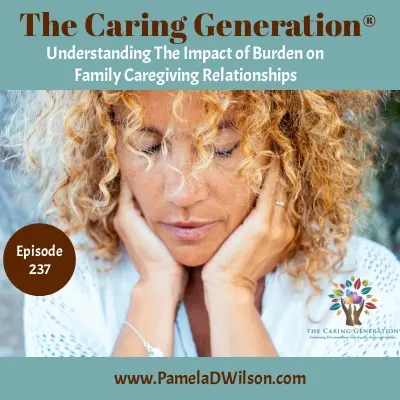
The Caring Generation®—Episode 237, January 28, 2026. How can children taking care of elderly parents overcome guilt or a sense of burden when caregiving and family relationships become strained? How can aging parents learn to rephrase common statements that have mixed meanings?
Caregiving expert Pamela D Wilson shares how simple statements can be interpreted differently, either positively or as placing blame on others, and offers tips to work through discussions about aging and eldercare.
This is a multi-media article feature.
Scroll down to read the article, select links to listen to the podcast, or watch the video. The article has links in “pink type” to related topics about caregiving, health, well-being, and self-care.
Click the round yellow play button below to listen to this episode. To download the episode, click the down arrow. You can also use the scroll bar below the photo at the right to check out prior episodes.
Share your question with Pamela by completing the caregiver survey, requesting a 1:1 consultation, or signing up for her newsletter on her Contact Me page.
Children Taking Care of Elderly Parents
Children taking care of elderly parents out of a sense of duty or responsibility can feel burdened as the hours they commit increase. Strong opinions can arise when the word ‘burden’ is used in the context of aging parents and elder care.
Some cultures or languages have no word for “burden.” Many cultures feel that caregiving is something that adult children do for elderly parents.
In conversations with family caregivers, adult children in certain cultures are beginning to question the duties and obligations they are expected to fulfill that create lifelong sacrifices demanded by older generations.
Opportunity exists for aging parents and elder care discussions within families to relieve caregiver stress around burden, duty, and responsibility around daily needs and in responding to emergency situations.
The Burden of Caring for Elderly Parents
 If the idea of caregiver burden feels insensitive, it can be replaced with the terms ‘duty’ and ‘responsibility’.
There are multiple participants in caregiving and family relationships, and thoughts of how duty and responsibility translate to caregiver burden. These include:
- Aging or elderly parents who don’t want to be a burden to their children, or those who already feel like a burden.
- Children taking care of elderly parents who unknowingly contribute to their parents feeling like a burden, or who want to be relieved of caregiving duties and responsibilities for aging parents and elder care.
Being a burden can mean depending on others for their time or resources, and relying on their goodwill or generosity for assistance.
Let’s look at how this shows up in caregiving and family relationships by looking at two things older adults commonly say.
“I Can’t Do the Things I Used to Do”
When you hear someone say, “I can’t do the things I used to do,” what is your first thought?
- Do you respond empathetically? Oh, this poor person. What can I do to help?”
- Or inquisitively? “Why not? Why can’t you do what you used to do?”
Maybe you don’t know what to say because you’re not sure of the intention behind the statement. You could respond by saying, “I don’t understand. What do you mean?”
- Do you want someone else to help you by placing duties and obligations on them?
- Are you looking to commiserate with other people who feel the same way? Just venting?
- Or is the statement thoughtful? “I must look at my habits to see what I’m doing or not doing so I can get back to doing the things I used to do.”
This simple statement can have so many interpretations. For children taking care of elderly parents, ask questions to understand the meaning and intention rather than assuming the worst.
Why Not Just Ask?
If you notice you can’t do the things you used to do and you don’t want to put in any effort to get back to your prior self, why not just ask your children to help?
Don’t beat around the bush. Don’t expect children to have a revelation that you are asking for their help when you might appear to be grieving a lost talent or activity.
Or if you are looking to return to a prior level of ability or activity, why not make it happen? It takes work to prevent hip fractures or other injuries that can result in a nursing home stay.
How Procrastination Burdens Others
 Procrastination about planning for aging and health can place a burden on children taking care of elderly parents.
So why do families delay discussing aging parents and elder care needs and planning? Ask these questions:
- Is it a low priority today, so it stays at the bottom of the list?
- Is the benefit uncertain, given the level of effort and time commitment?
- Is motivation lacking?
In the context of caregiving and family relationships, when adults procrastinate about health issues, saving money to pay for eventual care needs, naming a power of attorney agent, creating a living will, a will, or a trust, the plan gets kicked down the road. The result is usually a crisis that requires children’s involvement to take care of elderly parents.
Discussions about aging parents and elder care, when ongoing, can relieve uncertainty and stress that everyone may experience.
- Children taking care of their parents hesitate to discuss their parents’ needs because they may not know how to initiate conversations. Or maybe they’ve tried, and it didn’t go well.
- Aging parents may hesitate ask their children if they will be their caregivers because the topic may end up being an uncomfortable conversation. Or they’ve tried, and their children delayed the conversation to another day.
Eventually, as time passes, some event demands the conversation. A heart attack, a hip fracture, a diagnosis of dementia, or another serious condition.
This is when procrastination turns into crisis planning.
How to Stop Being or Feeling Like a Burden
So if you want to avoid being a burden or stop being a burden, start having caregiving and family conversations.
It’s okay if the conversations are uncomfortable. Ongoing conversations can increase comfort levels and may improve family relationships. Children taking care of elderly parents may be relieved that discussions are finally happening.
When basic planning tasks are underway or completed, you and your adult children will feel less stressed. When you have plans for aging and care, you are less likely to panic in response to unexpected situations.
Adult Children: How Did I Get Here?
Children taking care of elderly parents can gain insights by reflecting on their early and ongoing involvement.
- Did you help with a one-time project and never stop? It seemed like the easiest thing to do.
- Did you take over tasks your parents were doing because it was easier and more efficient? Translation: your parents are slow, and you are impatient.
When caregivers become overly helpful by providing elder care for aging parents, they can create unexpected burdens.
 Most children who want to be helpful to aging parents rarely think about the consequences of their actions.
Little or no thought is given to making an elderly parent increasingly dependent and less able to do things themselves.
And if a parent has dementia, more thought is needed to create a plan for their care.
At some point, the family caregiver feels burdened by duties and responsibilities and is exhausted.
How do children taking care of aging parents change the balance in caregiving dependency that they created?
I Can Do the Things I Used to Do
To change the dynamic around thoughts of being a burden, reverse the “I can’t “ in I can’t do the things I used to do to “I can.” This is relevant for aging parents and children taking care of elderly parents
Children Taking Care of Elderly Parents
Reverse the “I can’t” to “I can” and encourage your parent. Admit that you took over things an aging parent could do for themselves because of convenience or time frustrations.
Admit that you can’t keep doing everything you are doing for aging parents and elder care, so that you can return to doing the things you used to do.
Say “I can’t” do this anymore because I need time for myself. But, “I can” help you research caregiving agencies, find ways to be healthier, and look at assisted living communities so that you can help yourself.
Spend time with your family and friends, exercise, get promoted at work, walk the dog, and sleep in late on the weekends. Let your parents focus on self-care and elder care activities.
Non-Medical In-Home Care as an Alternative
Alternatively, if your parent cannot do all of the things they used to do, investigate and present other elder care options. A non-medical in-home caregiver can do many of the daily tasks an elderly parent used to do, and that children might have taken over.
 Exceptions for in-home non-medical care agencies include activities such as setting up medication boxes, treating wounds, providing medically related care, such as giving insulin injections, and assisting with medical and financial decision-making.
Don’t worry, having a caregiver assist, or even moving Mom or Dad to an assisted living community, won’t keep you from continuing to be involved with aging parents and elder care activities.
However, making other care arrangements will give you your time back.
How the Effects of Aging Can Contribute to Becoming a Burden
If you are an adult, saying, “I can’t do the things I used to do,” is it time to look at yourself and how you are caring for yourself?
If you are 30, 40, 50, or 60, and you have physical difficulty with daily activities or experience memory loss, your ability to do things won’t improve until you choose to do things differently. If you have memory loss, depending on the diagnosis, it’s important to plan for future care.
Looking at daily habits is a great place to start if you don’t want to become a potential care burden to a spouse or loved one.
Some of you may be saying, I can’t. Yes, you can.
Only you can take responsibility for the mind you use to create your everyday world. You can choose a different path or let the environment where you work or live dictate your experience.
Planning for aging and elder care needs is a conversation that benefits everyone in the family.
The Connection Between Environment and Physical Function
The environment can affect physical and mental function. The environment can be the people one spends time with or the physical environment.
 For example, research confirms that older adults who move to assisted living communities or nursing homes can decline to the level of the lowest performing individual unless they take action to maintain their physical and mental function.
Children taking care of elderly parents suffer physical and emotional health declines because they reduce the time spent with friends, their spouse, and their children. Their time is consumed in elder care activities. Family caregivers become stressed out and exhausted.
This highlights the importance of being proactive to maintain physical and mental activity throughout life.
Let’s look at a more common example. You are married, and your spouse is overweight, eats junk food, is inactive, and not healthy. Sooner or later, your spouse will need a caregiver.
Guess who gets the job? You. Did you get married so that your time could be spent taking care of a chronically ill spouse?
 If you stay in an environment of being unhealthy and follow the same habits and activities as an unhealthy spouse, guess what?
You’re probably going to be unhealthy like your spouse if you are not already.
Your children will eventually become your caregivers, and you will have passed down aging parent and elder care responsibilities and duties.
Choose Differently
Choose to change your eating habits, choose exercise, lose weight, and spend time with friends who have healthy habits. Aging and becoming frail do not happen to those who remain active and interested in life.
After all, if you’re going to be a caregiver, you have to take care of yourself first, before caring for anyone else. Caregiver stress combined with a lack of self-care is a recipe for increased health problems.
Learn how to deal with caregiver stress by taking a caregiver stress survey.
Your decision to improve your health might inspire your spouse and others. You can serve as an example for future generations to break the cycle of expectations around generational caregiving duties and responsibilities.
Lessons from Caring for Sick Aging Parents
Alternatively, if your home environment is good and you are a child caring for an elderly parent with health problems, their problems may be a wake-up call to plan today for aging and elder care.
Children taking care of elderly parents can feel burdened by the responsibility. This can lead to deciding that you don’t want anyone to feel this way about caring for you.
So, regardless of whether you are an aging parent or an adult child caring for a parent, being unable to do things you used to do is a 911 call. It’s a warning bell asking you to pay attention to your health before it’s too late.
Because needing care and relying on other people for their time and energy can make anyone feel like a burden. The way not to feel a burden is to take care of yourself and remain self-sufficient as long as possible.
Phrases Aging Parents Can Avoid Saying If They Don’t Want to Become a Burden to Their Adult Children
Click the red arrow button in the picture below to watch the video.
Watch More Videos About Caregiving, Aging, and Health on Pamela’s YouTube Channel
“My Kids Have Jobs and Families of Their Own”
The second statement about burden or feeling a duty and a responsibility that aging parents say is, “my kids have jobs and families of their own.”
This statement can also be viewed in at least three different ways.
Thank God
First, if you are a parent saying, “My kids have jobs and families of their own,” add on to the end of this statement, “thank God.” Do you know how many adult children are still living in their parents’ homes and relying on them for financial and emotional support? Too many.
These days, having adult children out of the house who are self-sufficient and live independently is a blessing. So thank God.
Feeling Sorry
Second, if saying “my kids have jobs and families of their own” is followed by “they’re too busy for me,” this can have different meanings. Children who work and raise children are busy.
Are you feeling sorry for yourself because you rely on your children for socialization? Instead of making them feel bad about not being able to spend time with you, spend time on activities you enjoy, work to improve the friendships you have, and make an effort to meet and make new friends.
Offer to Help
 Third, the idea that others are busy can enter any relationship. Friends may be too busy because they are at a different life stage. For example, if you are retired and your friends work, your daily and weekly obligations are different.
So what can you stay instead?
What about “It seems like you’re juggling a lot of things these days. I’d love to see you. Is there anything I can do to help you out that we could do together?”
Offer to help clean the house, clean out the garage, or do any task that can be done together.
If you want to spend time with loved ones, consider how the other person feels if they are busy and ask how you can help them instead of expecting them to focus on your needs.
Don’t Make Burden, Duty, or Responsibility About You
In the context of family caregiving relationships, aging parents and elder care, and burden related to duty and responsibility, what is the goal of your conversations? Words matter.
Is the intention to make others feel guilty so one person is the beneficiary of another’s time, resources, and generosity?
Making others feel guilty or burdened about being busy is more about the person making the statement than about others. Consider the meaning and intentions of words on aging parents and children taking care of elderly parents.
Aging Parents and Elder Care Probabilities
What can aging parents who may eventually need help offer in return to their children?
One of the most important conversations that families fail to have is around the medical, legal, and financial aspects of care planning. Procrastination can lead to a burden focused on aging parents and elder care, so don’t delay.
Talking about aging parents, elder care, and care planning is a discussion for the entire family. All generations can be involved and learn that talking about aging and the need for care is part of life.
Children taking care of elderly parents must consider making their own aging and elder care plans.
Aging Successfully and Joyfully
 How many consider the probability of aging successfully and what it takes to make this happen? Taking good health for granted can result in disappointing retirement years.
Learn the habits of people who age successfully.
Rather than being able to do the things one dreams of, retirement years can be consumed by dealing with health issues and caregiving. It’s important to have coping strategies for difficult times.
Aging parents and elder care discussions that begin early in life and are ongoing can lead to parents and the entire family living happier, more fulfilled lives with fewer significant care needs.
Achieving this goal takes looking at things differently, researching, discussing, and considering a variety of options.
 If you are an aging adult who doesn’t want to be a burden or place duty or responsibility on your children, what steps can you take to increase the probability of making that happen?
If you are healthy today, be thankful. Create a plan for what to do when the unexpected occurs.
Children taking care of elderly parents often face unexpected situations. It’s best to be prepared and have options rather than procrastinate and place the burden of your care and planning on others.
When aging parents and adult children talk about elder care, caregiving and family relationships are relieved of unnecessary stress and indecision about what parents want for their care and the care expectations of parents for adult children.
If you or your family is struggling to discuss issues related to family dynamics, health, healthcare, or the legal and financial aspects of care, caregiving expert Pamela D. Wilson can help facilitate these conversations.
Looking for 1:1 Individual Caregiver or Family Support? Meet with Pamela D Wilson
©2026 Pamela D. Wilson All Rights Reserved